After the Attention Tax: The Strategic Playbook for Retail Media Leaders in the AI Agent Era

This is part 5 of a series of six articles. Be sure not to miss Part 1 – Retail Media 2.0: Introducing Retail Performance, Part 2 – The Strategic Evolution of E-Commerce, Part 3 – Retail Performance: The Keystone, Part 4 – The Attention Tax: Why AI Agents Will Dismantle Retail Media, and Part 6 – The Hail Mary.
In Part 4, I argued that AI shopping agents will systematically erode the Retail Performance Flywheel by eliminating the scarcity that makes it work: human attention. The attention tax — the tens of billions flowing into e-commerce advertising — becomes uncollectable when the "visitor" is an algorithm that doesn't scroll, doesn't browse, and doesn't see your Sponsored Products.
The natural follow-up is: so what do you do?
Here is the uncomfortable truth. The strategically correct answer involves cannibalizing the most profitable business your company operates. It requires building capabilities that compete with your own revenue model for resources. It demands the kind of organizational courage that most companies talk about in offsites and abandon in budget season.
But there is also good news. The platforms best positioned to make this transition are exactly the ones currently running Retail Performance flywheels — because they have the cash flows, the data, and the seller relationships to fund a transformation. The question is not capability. It is will.
The Core Framework: Harvest and Hedge
Every recommendation in this article follows a dual logic that I want to make explicit, because without it, the strategy makes no sense.
Harvest means running the Retail Media and Retail Performance playbook at full intensity. The flywheel still works. Sponsored Products still generate extraordinary margins. Human-mediated shopping still dominates e-commerce. For the next three to five years — possibly less, given the innovation speed trap I described in Part 4 — the existing Retail Media model is the primary revenue engine. Nothing in what follows suggests abandoning it.
Hedge means building, in parallel, the infrastructure and business models that sustain the platform when Retail Media's attention-based economics weaken. The hedge is not a corporate venture arm or an innovation lab. It is a core strategic initiative funded by the harvest, with board-level sponsorship and P&L accountability.
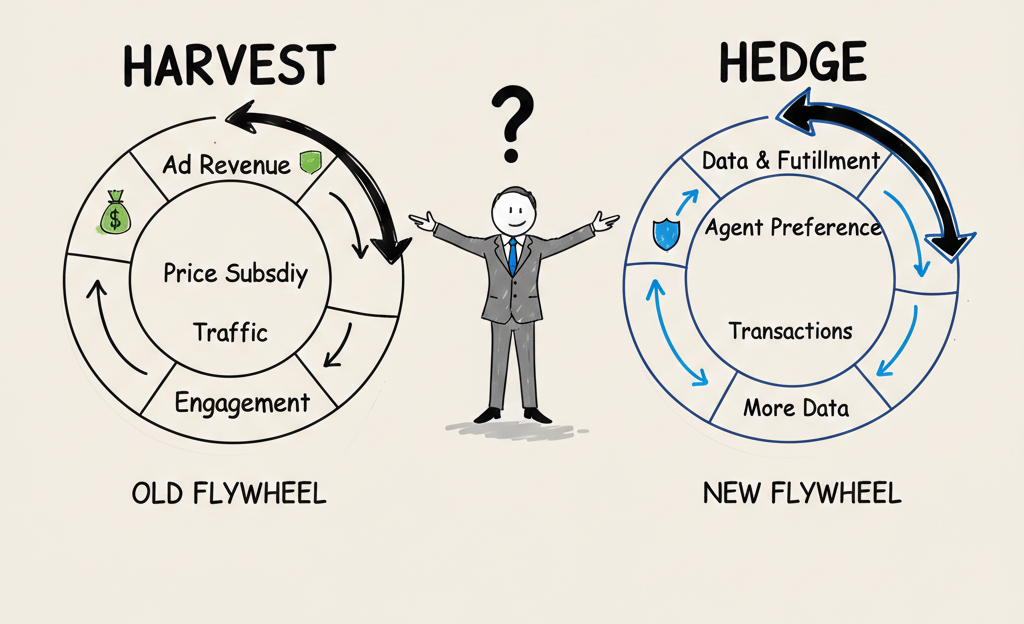
The companies that execute both simultaneously will define the next era of Retail Media and digital commerce. Those that only harvest will discover, too late, that they spent their transformation budget optimizing a peak.
Now, the seven moves.
Move 1: Transform Your API into Your Primary Retail Media Storefront
This is the single most important strategic reorientation in this entire playbook.
When an AI shopping agent decides where to purchase a product, it does not navigate to a homepage or browse Sponsored Products. It calls an API. The platform with the richest, fastest, most reliable structured data wins the agent's recommendation — and with it, the transaction.
Most platforms treat their APIs as plumbing — technical infrastructure for inventory syncs and affiliate integrations. This is like treating your storefront as a loading dock. In an AI agent-mediated world, the API is the first thing a customer encounters. Except the customer is an algorithm, and its standards are merciless.
Tiered data depth. Basic product and pricing data is table stakes. The premium tier includes signals that AI agents desperately want but cannot get elsewhere: real-time inventory by fulfillment location, granular delivery estimates calibrated to the user's address, seller quality scores computed from millions of transactions, category-specific return rates, and product durability indicators derived from warranty claim data. Agents that integrate at the premium tier make better recommendations, which drives more transactions to the platform. This is a new flywheel — and unlike the Retail Media flywheel, it does not depend on human eyeballs.
Structured merchandising feeds for AI agents. This is where Retail Media begins its metamorphosis. A Sponsored Product in a human context is a visual placement in search results. A Sponsored Product in an AI agent context is a structured data object with enhanced attributes — a guaranteed price lock, expedited shipping, an extended return window, a verified authenticity certificate. If the sponsored offer is objectively better for the user on measurable dimensions, the agent has a rational reason to surface it. Not because it was paid to, but because it serves its user better. This is the embryo of Agent Media.
API speed as competitive advantage. When an AI agent spawns parallel queries across twenty platforms, it favors the ones that respond fastest. Fifty-millisecond response times beat five hundred milliseconds not marginally but categorically — because the agent can query the fast platform, receive results, and begin evaluation before the slow platform has even responded. Investing in API performance is investing in AI agent preference.
Move 2: Build Agent Media — The Successor to Retail Media
This is the move that will meet the most internal resistance, because it directly challenges the Retail Media revenue model that funds the entire organization.
Retail Media monetizes human attention through Sponsored Products, Sponsored Brands, and display advertising. Agent Media must monetize something fundamentally different: decision-relevant advantage in AI agent evaluation.
The underlying seller need doesn't change. Sellers still want their products to reach buyers. What changes is the medium. In human-mediated commerce, the medium is visual attention — sellers pay for Retail Media placements, and humans see the product. In AI agent-mediated commerce, the medium is structured advantage — sellers pay for conditions that make their product objectively win the agent's evaluation.
Conditional advantages. Sellers fund real, measurable benefits — free express shipping, price-match guarantees, extended warranties, priority fulfillment — that the platform bundles into a promoted offer within AI agent data feeds. The agent evaluates this offer alongside organic alternatives and surfaces it when it is genuinely superior on objective criteria. This is advertising that survives the death of human attention, because it creates tangible value rather than capturing eyeballs. The seller pays for performance. The buyer gets a better deal. The platform takes a margin. This is sustainable Retail Media for the agent era.
Data enrichment as Retail Media. Sellers pay for richer product data in AI agent feeds — detailed specifications, compatibility matrices, verified performance claims, professional imagery with structured metadata. In a world where AI agents decide based on information quality, the depth and reliability of product data becomes the new Retail Media placement. A seller with sparse product data loses to a seller with comprehensive structured data, regardless of price — because the agent cannot recommend what it cannot fully evaluate.
Outcome-based pricing. CPM and CPC pricing models were designed for human browsing sessions. Agent Media should price on outcomes: cost per completed transaction, revenue share on agent-recommended purchases, cost per AI agent recommendation. This aligns seller Retail Media spend with actual results and remains viable regardless of how purchase transactions are initiated — by human or by agent.
Move 3: Make Fulfillment the Moat That AI Agents Cannot Bypass
In a world where AI agents make price and product information perfectly transparent across all Retail Media platforms — and they will — one competitive differentiator cannot be parallelized, scraped, or arbitraged away: the physical movement of goods.
An AI agent can compare prices across twenty platforms in milliseconds. It cannot make a package arrive faster. It cannot improve the return experience. It cannot build a warehouse closer to the customer.
Same-day delivery, reliable two-hour windows, frictionless returns, integrated in-store pickup — these are capabilities rooted in physical infrastructure, not information. When two platforms offer the same product at the same price — which AI agents will ensure happens with increasing frequency — the agent recommends the platform that delivers faster, more reliably, and with less friction.
This reframes fulfillment from a cost center to the single most important competitive asset in AI agent-mediated e-commerce. Amazon understood this before anyone else, which is why it invested over $100 billion in logistics infrastructure while competitors optimized their Retail Media operations. In hindsight, that wasn't a bet on operational efficiency. It was a bet on exactly the world we are now entering — one where the platform that moves atoms best wins, because moving bits has become a commodity.
Move 4: Weaponize Proprietary Data as a New Retail Media Asset
Here is a sentence that should appear on the wall of every Retail Media strategy department:
E-commerce platforms possess data that no AI agent can independently obtain.
Post-purchase satisfaction scores. Product-level return rates. Seller reliability metrics computed across millions of transactions. Fraud patterns. Durability signals from warranty claims. Customer service escalation rates by product and seller. Refund-to-purchase ratios by category.
This information is not available via web scraping. It is not available via price comparison APIs. It is not available anywhere except inside the platform's own transaction systems. And it is extraordinarily valuable for AI agent decision-making.
Consider: an AI agent evaluating two running shoes at similar prices cannot, from external data alone, determine that one has a 3% return rate and the other 28%. If one platform surfaces this signal — through a premium data layer available to integrated AI agents — the agent will systematically favor that platform for categories where return risk matters. Which is essentially all categories.
This is not Retail Media in any traditional sense. It is information asymmetry as a service. The platform monetizes not attention but trust: the AI agent trusts the platform's proprietary data to produce better recommendations, which drives transactions to the platform, which generates more proprietary data, which deepens the trust.
A new flywheel emerges — one built on data quality and transaction intelligence rather than Sponsored Products and display impressions.
Move 5: Build Destinations That AI Agents Cannot Replicate
The previous four moves address the AI agent-mediated channel. But there is a parallel strategic imperative: preserve a meaningful share of direct human interaction on the platform — because as long as humans browse, traditional Retail Media works.
The naive version of this strategy is hyperpersonalization — using platform data to create an experience so individually tailored that users keep returning. My analysis shows this is a weak moat in isolation. The reason: an AI agent working for the user has access to her entire digital context — calendar, budget, conversations, purchase history across all platforms. The agent will always personalize better than any single Retail Media platform working with a partial data view.
What platforms can offer instead is something AI agents fundamentally cannot replicate: a place to be, not just a place to buy.
Community and social commerce — reviews with personal context from verified purchasers, live shopping events, creator collaborations, user-generated style guides — create belonging and identity. An AI agent can find the cheapest moisturizer. It cannot replicate the experience of discovering it through a live demonstration by a dermatologist whose advice you've followed for two years.
Co-creation and customization tools — product configurators, personalized bundles, made-to-order options — make the product itself inseparable from the platform interaction. The AI agent cannot extract and replicate an experience that exists only in the act of creating it.
Discovery as entertainment — editorial curation, trend forecasting, seasonal inspiration, community-curated collections — serves users who are not optimizing a purchase but enjoying a process. This is the dimension of commerce that AI agents will disintermediate last, because the user is not trying to be efficient. She is trying to be inspired, surprised, or entertained.
These experiences serve a dual strategic purpose: they generate direct revenue through engaged human visitors, and they provide a temporal bridge that preserves Retail Media economics while the platform builds its agent-era capabilities.
Move 6: Build a Platform-Native AI Shopping Agent
If the AI agent layer is where future market power concentrates — and Part 4 made this case — then Retail Media platforms must compete in that layer directly.
This means building a platform-native AI shopping agent. Not a chatbot enhancement. Not a smarter search bar. A full-service AI purchasing agent that operates on behalf of the user across the entire market — including competitor platforms.
The objection is immediate: an AI shopping agent built by Amazon, Otto, or Zalando will face perpetual skepticism about whether it truly serves the user or subtly steers toward the platform's own marketplace and Retail Media partners. This is a real constraint. But it is not fatal.
First, the alternative is worse. Ceding the AI agent layer entirely to third parties — OpenAI, Google, Apple, or specialized startups — means ceding the user relationship. For an aggregator built on Retail Media, the user relationship is the foundational asset. Losing it is not a strategic setback. It is an existential event.
Second, the trust problem is solvable through radical transparency: open decision criteria, verifiable price comparisons across competitors, user-configurable preference settings with auditable agent behavior. A platform AI agent that demonstrably finds cheaper options on competing sites — and tells the user — builds more trust than any third-party agent that claims neutrality without proof.
Even capturing a fraction of AI agent-mediated commerce through a proprietary agent preserves a channel where the platform controls the experience, the data, and the Retail Media monetization. In a world where third-party AI agents threaten to reduce platforms to interchangeable backends, this is not an offensive play. It is survival.
Move 7: Shape the Regulatory Framework for AI Agents and Retail Media
The regulatory framework governing AI agent interactions with e-commerce and Retail Media platforms does not yet exist. Questions of data access rights, platform scraping rules, AI agent liability, Retail Media disclosure requirements, and competitive fairness are emerging but unresolved.
This is an enormous opportunity for Retail Media platforms that engage now.
The strategic posture should be constructive, not defensive. Lobbying to block AI agents would be futile — the technology is too valuable to consumers. Instead, platforms should shape regulation in ways that favor their structural advantages:
AI agent interaction standards. Defined protocols for how AI agents query Retail Media platforms, what data they can access, and under what commercial terms. Platforms with rich data infrastructure benefit from standards that reward data depth and penalize shallow scraping.
AI agent certification. A trust framework distinguishing AI agents that operate transparently in the consumer's interest from those that accept undisclosed payments for preferential product recommendations. This protects consumers and creates barriers to low-quality agent proliferation — while legitimizing Agent Media as a transparent, disclosed format.
Retail Media disclosure requirements for AI agents. If AI agents surface sponsored or promoted results, consumers should know — just as they know when search results are paid placements. Platforms that proactively champion Retail Media transparency in AI agent contexts position themselves as consumer advocates in regulatory negotiations.
The New Retail Media Flywheel for the AI Agent Era
If these seven moves are executed together, they form the basis of a new flywheel — one designed for a world where the attention tax can no longer sustain Retail Media growth.
The old Retail Media flywheel: Ad revenue → price subsidy → more human traffic → more browsing engagement → more Retail Media ad revenue.
The new Retail Media flywheel: Superior data and fulfillment → AI agent preference → more transactions → more proprietary data → deeper agent integration → stronger agent preference → sustainable platform revenue.
This flywheel is less glamorous than its predecessor. The margins may be thinner. The growth curves less explosive. It will not produce the intoxicating quarterly Retail Media revenue beats that the industry has celebrated over the past five years.
But it is adapted to the structural reality of AI agent-mediated commerce. And in strategy, adapted to reality beats optimized for the past every single time.
The Real Question for Every Retail Media Leader
I want to end this series where it began — with the Retail Performance Flywheel I described in Part 1.
That flywheel is the most powerful profitability mechanism in modern e-commerce. It works. It is working right now. And every Retail Media leader should continue to operate it at maximum intensity for as long as it produces returns.
But they should do so with clear eyes about what they are operating: not an engine of perpetual growth, but a cash machine with a defined — and shortening — operational lifespan. The purpose of the harvest is to fund the hedge. The purpose of the hedge is to ensure that when the Retail Media flywheel slows, the company is already running on something else.
The platforms that understand this will spend the next few years doing something unusual: investing heavily in a Retail Media business that is still growing while simultaneously building its replacement. This is extraordinarily difficult. It violates every instinct of quarterly-driven management. It requires explaining to boards and shareholders why you are investing hundreds of millions in AI agent capabilities that compete with your own most profitable product.
But the alternative is simple, and it is fatal: optimize the Retail Media flywheel all the way to its peak, celebrate the record advertising margins, and then discover — too late — that the attention you were taxing has found a way to stop paying.
The AI agents are not coming. They are here. The question is no longer strategic. It is operational: are you building the next Retail Media model, or are you only harvesting the current one?
Both is the only right answer. And the time to start both is now.
Key Takeaways
- Harvest and Hedge: Continue running Retail Media at full intensity while simultaneously building agent-era capabilities. The current Retail Media model funds the transition to the next one.
- API as Storefront: Transform platform APIs from technical plumbing into the primary interface for AI agent commerce. Tiered data depth creates a new competitive flywheel.
- Agent Media: Build the successor to Retail Media — structured, outcome-based seller monetization designed for AI agent evaluation rather than human attention.
- Fulfillment Moat: Physical logistics is the one competitive advantage AI agents cannot digitize or bypass. Invest disproportionately.
- Proprietary Data: Platform-exclusive transaction intelligence becomes the new Retail Media asset — information asymmetry as a service.
- Destination Experiences: Community, co-creation, and editorial discovery preserve human browsing — and with it, traditional Retail Media revenue — as a temporal bridge.
- Platform Agent: Build a proprietary AI shopping agent to defend the user relationship against third-party agent disintermediation.
- Regulatory Engagement: Shape the emerging rules for AI agent commerce now, while the framework is still being written.
Frequently Asked Questions
What is Agent Media?
Agent Media is the proposed successor to traditional Retail Media. While Retail Media monetizes human attention through visual advertising formats (Sponsored Products, display ads, promoted listings), Agent Media monetizes decision-relevant advantage in AI agent evaluation. Sellers pay for enhanced product conditions — faster shipping, price guarantees, richer data — that make their products objectively superior in AI agent recommendations. Agent Media creates value for consumers rather than capturing attention.
How should Retail Media platforms prepare for AI agents?
Retail Media platforms should execute a dual strategy: harvest current Retail Media revenue at full intensity while hedging with seven strategic moves — building agent-grade APIs, developing Agent Media products, investing in fulfillment infrastructure, weaponizing proprietary data, creating non-replicable platform experiences, launching platform-native AI agents, and shaping emerging regulations.
Will Retail Media be replaced by Agent Media?
Not immediately. Retail Media and Agent Media will coexist for several years as human-mediated and AI agent-mediated shopping overlap. The transition will be gradual, with Agent Media growing as a share of total platform advertising revenue while traditional Retail Media formats decline. Platforms that build Agent Media capabilities now will be positioned to capture this shift.
What is the new Retail Media flywheel?
The new flywheel replaces attention-based Retail Media economics with data-and-fulfillment-based economics: superior data and fulfillment quality earn AI agent preference, which drives more transactions, which generates more proprietary data, which enables deeper AI agent integration, which strengthens agent preference further. This cycle does not depend on human browsing behavior.
Why is fulfillment the key competitive advantage against AI agents?
AI agents can instantly compare prices, product data, and reviews across all platforms. They cannot change the physical speed of delivery, the reliability of shipping, or the quality of returns processing. When AI agents make product information perfectly transparent, fulfillment quality becomes the primary differentiator — the one competitive moat that algorithms cannot bypass.
What is the Harvest and Hedge strategy for Retail Media?
Harvest and Hedge is a dual execution framework for Retail Media leaders. "Harvest" means continuing to operate the current Retail Media flywheel at maximum intensity — it remains the primary revenue engine. "Hedge" means building agent-era capabilities in parallel, funded by Retail Media cash flows, with board-level accountability. The window for this dual execution is finite: once Retail Media revenue begins declining, the resources to fund the hedge diminish.
How will AI agents affect Retail Media advertising formats?
Traditional Retail Media formats — Sponsored Products, Sponsored Brands, display ads — are designed for human visual attention and will lose effectiveness as AI agents mediate more purchases. New formats will emerge: structured data enrichment, conditional advantage bundles, outcome-based seller promotions, and premium API access tiers. These Agent Media formats are optimized for algorithmic evaluation rather than human browsing.
Next in this series is >> Part 6 – The Hail Mary