The Attention Tax: Why AI Agents Will Dismantle Retail Media

This is part 4 of a series of six articles. Be sure not to miss Part 1 – Retail Media 2.0: Introducing Retail Performance, Part 2 – The Strategic Evolution of E-Commerce, Part 3 – Retail Performance: The Keystone, Part 5 – After the Attention Tax: The Strategic Playbook, and Part 6 – The Hail Mary.
Retail Media is the best business in e-commerce. It is high-margin, self-reinforcing, and growing faster than the platforms it sits on. Amazon's advertising revenue alone surpassed $46 billion in 2023, with margins exceeding those of AWS at the same maturity stage. Every major marketplace — from Otto to Zalando, Walmart to Mercado Libre — is building or scaling a Retail Media operation. The industry consensus is unanimous: Retail Media is the future of e-commerce profitability.
I built that thesis myself, across the first three parts of this series. I described how Retail Media evolves into Retail Performance — a self-reinforcing flywheel where advertising revenue subsidizes pricing, lower prices attract more users, more users generate more engagement, and more engagement produces more advertising revenue. Winner takes all.
I believe that analysis is correct. I also believe it describes a model whose foundational assumption is about to be invalidated by AI agents.
The Hidden Assumption Behind Every Retail Media Strategy
Every strategic model has load-bearing assumptions. The dangerous ones are invisible — so embedded in the logic that nobody questions them. The Retail Media model, and the broader Retail Performance framework, rests on one such assumption:
All e-commerce is mediated by a human who can only look at one screen at a time.
This is not a minor technical detail. It is the reason aggregator platforms exist. It is the reason Retail Media works. It is the reason Sponsored Products generate billions in revenue.
Consider how a human shops online. She types a query into a search bar. She scrolls through results — organic listings and Sponsored Products side by side. She clicks on a product, reads the description, checks reviews, maybe compares two or three alternatives, and eventually converts. At every step, she operates in a single thread: one query, one page, one decision at a time.
This sequential, single-threaded behavior is what makes Retail Media valuable. Sponsored Products work because they appear in a stream of attention the user is already committed to. Display ads work because the user is lingering on a product page. Every CPM, every CPC, every ROAS calculation in Retail Media is predicated on one thing: scarce human attention directed at a platform.
The platform charges what I call an attention tax — it monetizes the fact that humans must concentrate their limited cognitive bandwidth on a single interface. The tens of billions flowing into Retail Media globally are, fundamentally, a tax on the inability of humans to be in more than one place at a time.
AI agents don't pay that tax.
How AI Shopping Agents Change the Economics of Retail Media
An AI shopping agent operating on behalf of a consumer does not browse. It does not scroll. It has no eyeballs to monetize and no attention to capture. It executes.
When a user asks her AI agent to find the best running shoes for her needs and budget, the agent does not navigate to Amazon, scroll through Sponsored Products, and maybe check one competitor. It spawns thousands of parallel queries — across marketplaces, direct-to-consumer sites, niche retailers, outlet stores, and resale platforms. Simultaneously. In the time it takes a human to read one product title, the agent has evaluated the entire market.
This is not a marginal improvement in shopping efficiency. It is a categorical change in the economics of e-commerce. The difference between a human shopper and an AI agent is not the difference between walking and driving. It is the difference between reading one book and reading every book ever written — at the same time.
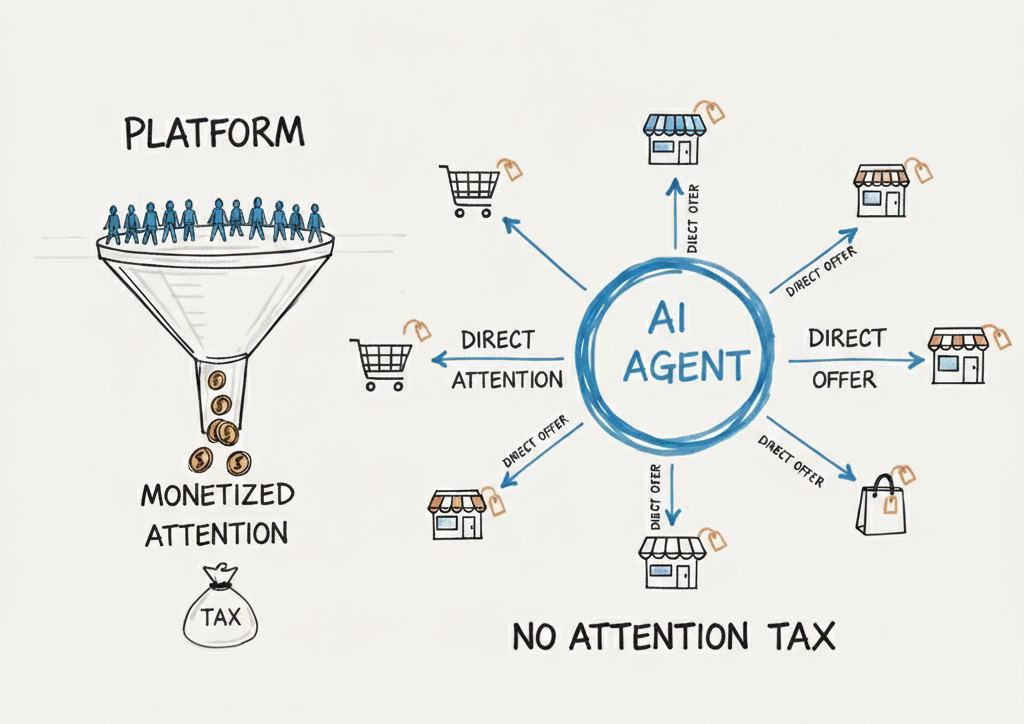
The aggregator's entire value proposition — "come here because we have everything in one place" — becomes irrelevant when the agent can be everywhere at once.
The platform says: "Our Retail Media placements will help you discover new products." The agent says: "I don't discover. I evaluate. Show me your structured data."
The platform says: "Our recommendation engine personalizes your experience." The agent says: "I know your calendar, your budget, your taste, your purchase history across every platform, and what you told your friend about wanting something lightweight. I personalize better than you ever could."
The attention tax only works when there is attention to tax.
The Retail Performance Flywheel: A Mechanical Autopsy
In Part 1, I described the Retail Performance Flywheel — the self-reinforcing cycle that transforms e-commerce platforms into market aggregators. Let me now show, component by component, how AI agents reverse that cycle.
Gear 1: Retail Media Revenue Erosion
Retail Media monetizes impressions — human eyes on Sponsored Products, display ads, and promoted listings. When the "visitor" is an AI agent executing an API call, there is no impression to sell. No eyeballs, no CPM, no click-through rate.
As AI agent-mediated shopping grows from 5% to 15% to 30% of purchase decisions, the addressable pool of human attention on the platform shrinks proportionally. Retail Media revenue doesn't collapse overnight — it erodes, quarter by quarter, like a tide going out so slowly that nobody notices until the boats are grounded.
Gear 2: Dynamic Pricing Subsidy Collapse
In Part 2, I demonstrated how Retail Media revenue funds dynamic pricing: reducing product prices from €50 to €47 increased traffic by 10% and total profitability by 32.8%. This pricing strategy depends on Retail Media revenue being large enough to fund the subsidy.
As Gear 1 slows, the available subsidy shrinks. Prices must edge upward to maintain margins. But — and this is the compounding cruelty — AI agents make price comparison frictionless. The moment prices rise on one platform, the agent identifies the cheaper alternative in milliseconds. The platform loses volume precisely when it needs volume most.
The Retail Performance Flywheel doesn't merely slow. It begins to reverse.
Gear 3: Traffic Quality Degradation
Even if transaction volumes hold steady, the nature of platform traffic degrades. A human browsing session involves minutes of engagement — scrolling, clicking, reading, comparing. An AI agent transaction is a data ping: query, evaluate, purchase. Dwell time collapses. Page views per session collapse.
The metrics that underpin every Retail Media pitch deck — session duration, pages per visit, scroll depth, viewability rates — all deteriorate. The traffic is still there. The monetizable attention is not.
Gear 4: Seller Ad Spend Reallocation
Sellers invest in Retail Media — Sponsored Products, Sponsored Brands, display advertising — because these formats capture buyer attention on the platform. If buyers increasingly delegate purchasing to AI agents that bypass search results entirely, the return on Retail Media spend diminishes.
Rational sellers will reallocate budgets toward whatever influences AI agent decisions: structured product data, competitive pricing, fulfillment speed, and enhanced product attributes. The supply side of the Retail Performance Flywheel, which depends on growing seller investment in Retail Media, weakens.
Four gears. Each one degraded by the same force. The flywheel that drives e-commerce aggregation becomes the anatomy of decline.
The Aggregation Inversion: When Retail Media Platforms Become Suppliers
This is where the analysis becomes uncomfortable for anyone who has studied Ben Thompson's Aggregation Theory — as I have extensively.
The theory holds that in a world of zero distribution costs, power accrues to platforms that own the user relationship. They attract demand (users), which attracts supply (sellers), which attracts more demand. The aggregator wins by controlling the interface between supply and demand.
Retail Performance, as I argued in Part 3, is the mechanism through which e-commerce platforms become aggregators. Retail Media-funded dynamic pricing and data-driven advertising create a gravitational pull that draws both sides of the market to the platform.
AI agents invert this entirely.
Today's Retail Media value chain: Human → Platform (Aggregator) → Sellers. The platform controls the interface and charges the attention tax.
Tomorrow's value chain: Human → AI Agent (New Aggregator) → Multiple Platforms and Shops → Sellers. The agent controls the interface.
In the new architecture, the e-commerce platform is not the aggregator. It is a supplier competing for the AI agent's recommendation — occupying precisely the position that sellers occupy on platforms today.
Platforms that spent a decade mastering aggregation through Retail Media are about to be aggregated themselves.
The winner-takes-all dynamics described in Part 1 don't disappear. They migrate. The question shifts from "which Retail Media platform attracts the most users?" to "which AI agent earns the most consumer trust?" Different question. Different winners. Different moats entirely.
The Innovation Speed Trap: Why "We Have Three to Five Years" Is Wrong
There is a predictable response to this analysis from Retail Media executives: "The technology isn't ready. We have three to five years to respond."
This is the most expensive sentence in corporate strategy, and it reflects a fundamental misunderstanding of AI development velocity.
The defining characteristic of the current AI cycle is not any single capability. It is the rate of capability gain. AI systems that could handle simple search queries twelve months ago now conduct multi-hour autonomous work sessions — researching, comparing, negotiating, purchasing. Error rates halve not over years but over quarters. The scope of what an AI agent can manage expands in discrete jumps, each one rendering the previous generation's limitations irrelevant.
Every Retail Media strategy that concludes "AI agents cannot yet do X, therefore our model is safe" is making an implicit bet: that the pace of AI progress will slow. This bet has been wrong in every major technology transition of the past three decades.
I call this the innovation speed trap: the tendency to benchmark against current AI capabilities and plan accordingly, like watching a child take its first steps and concluding it will never outrun you. The child is already running. The question is whether you have started building the infrastructure for what comes next — or whether you're still optimizing the infrastructure you already have.
The strategic window during which Retail Media leaders can build AI agent-era capabilities — while still funding them with Retail Media cash flows — is finite. And it is shorter than any boardroom timeline currently assumes.
What the End of the Attention Tax Means for Retail Media
Let me restate the argument with the precision it deserves.
Retail Media is an attention tax. It is enormously profitable because human attention is scarce, and e-commerce platforms that aggregate supply can charge sellers for access to that attention. The Retail Performance Flywheel — the most powerful profitability mechanism in modern e-commerce — is the apparatus for maximizing that tax.
AI shopping agents eliminate the scarcity. They can attend to everything, everywhere, simultaneously. They have no cognitive bandwidth to constrain. They have no need for a single aggregated destination. They render the attention tax uncollectable.
This does not mean Retail Media revenue will disappear next quarter. It means Retail Media has peaked — structurally, if not yet in the reported numbers. What the industry is witnessing is the highest, most refined expression of a business model whose foundational assumption is being removed from underneath it.
Every company building a Retail Media strategy today should ask one question: What does our Retail Media business model look like when 40% of our platform visitors are no longer human?
The next article in this series proposes an answer.
Key Takeaways
- The Attention Tax: Retail Media monetizes scarce human attention. AI agents eliminate that scarcity by parallelizing purchase decisions across the entire market.
- The Flywheel Reversal: The four gears of the Retail Performance Flywheel — ad revenue, price subsidies, traffic quality, and seller investment — are each degraded by AI agent adoption.
- The Aggregation Inversion: AI agents become the new aggregators. E-commerce platforms shift from controlling the user interface to competing for agent recommendations.
- The Innovation Speed Trap: AI capabilities are advancing faster than most Retail Media strategies account for. Planning based on current AI limitations is a strategic error.
- The Strategic Imperative: Retail Media leaders must begin building AI agent-era capabilities now, while Retail Media cash flows still fund the transition.
Frequently Asked Questions
What is the Attention Tax in Retail Media?
The Attention Tax is the economic mechanism by which e-commerce platforms monetize human cognitive limitations. Because humans can only browse one platform at a time, platforms charge sellers — through Sponsored Products, display ads, and other Retail Media formats — for access to that concentrated attention. AI shopping agents bypass this mechanism entirely because they evaluate products across all platforms simultaneously.
How do AI agents affect Retail Media revenue?
AI shopping agents reduce Retail Media revenue by eliminating monetizable human attention from the platform. Agents don't see Sponsored Products, don't click display ads, and don't respond to visual merchandising. As agent-mediated purchasing grows, the pool of human impressions available for Retail Media monetization shrinks, reducing CPMs, click-through rates, and overall advertising revenue.
What is the Retail Performance Flywheel?
The Retail Performance Flywheel is a self-reinforcing cycle where Retail Media advertising revenue subsidizes product pricing, lower prices attract more users, more users generate more engagement, and more engagement produces more advertising revenue. This flywheel drives e-commerce platforms toward market aggregation and winner-takes-all dynamics. AI agents threaten this cycle by degrading each of its four components.
Will Retail Media disappear because of AI agents?
Retail Media will not disappear immediately. Human-mediated shopping will continue to represent a significant share of e-commerce for years. However, the structural peak of Retail Media — as a percentage of platform profitability and as a growth trajectory — is approaching. Platforms that depend exclusively on attention-based Retail Media models face declining returns as AI agent adoption accelerates.
What is the Aggregation Inversion?
The Aggregation Inversion describes the shift in market power from e-commerce platforms to AI agents. Under Aggregation Theory, platforms win by controlling the user relationship. When AI agents become the primary interface between consumers and commerce, the agent — not the platform — controls the user relationship. Platforms are reduced from aggregators to suppliers competing for agent recommendations.
How fast are AI agents developing?
AI agent capabilities are advancing at an exponential rate, with meaningful capability jumps occurring quarterly rather than annually. Systems that performed simple search queries twelve months ago now conduct autonomous multi-hour purchasing sessions. Strategic planning based on current AI limitations consistently underestimates the pace of change.
Next in this series is >> Part 5 – After the Attention Tax: The Strategic Playbook